What kind of violin is the best choice for you?
In this article I describe the different types of violins and related instruments
Predessecors of the violin
The violin is developed from 15th and 16th century bowed instruments like the vielle, rebec and lira da braccio. If you want to read more about the history of the violin, click here to read my article.
Baroque violin
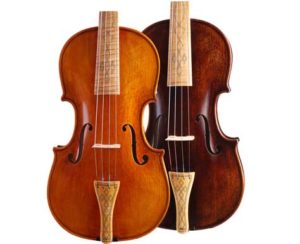 The violin like it was played from the 16th to the 18th century, is called the baroque violin. Famous makers were Amati, Stradivarius and Guarneri. Their instruments are still played today and sold for millions. When such an old instrument is played on in a concert, most of the times it's changed into a 'modern' violin. Click here to read my article about the history of the violin, in which I explain all about the differences between the baroque violin and the 'modern' violin we play on today.
Violin family
The 'violin family' we see today in orchestra's consists of the violin, viola and cello. In folk music, we also see the Hardanger fiddle and the Swedish Nyckelharpa.
Violin
The violin is the smallest instrument with the highest pitch. The strings are tuned G, D A, and E. This is the most popular instrument of the violin family. It's used in various music styles.
First and second violin
Some people think the first and second violin in an orchestra are different. The instrument however is the same. The difference is that they play a different part. Usually the first violins play higher and have more melodies. The second violins play a bit lower and have a 'middle' part.
Viola
The viola is played almost in the same way as the violin, but is larger and sounds a fifth lower. The viola, just as the second violin, plays the 'middle voice' in an orchestra. There are also solo concerts written for the viola and there are many composers fond of the deep and warm sound of this instrument.
The viola is a good instrument to start on as an adult beginner
If you like playing together, the viola is a good choice. In lots of music the scores are a bit easier, violists are scarce and in demand and you don't have the trouble of a squaking E string. Of course, determine what instrument speaks to you most by listening to various music. Have you heard the Walton concerto?
Cello
The cello is a much larger instrument with a lower pitch: an octave lower than the viola. Because of the size it's played upside down between the knees resting on it's endpin.
You'll see cello's in every symphony orchestra. Besides that there are beautiful solo concerts and lots of chamber music. Have you heard the Elgar concerto?
Violone
The violin family also knows the violone (even larger and lower than the cello), but it's a very rare instrument that is replaced by the double bass in symphony orchestra's.
Double bass
The double bass is not really part of the violin family as it emerged from the older family of viola da gamba (instruments with sloping shoulders). Double basses are built in violin shape and gamba shape these days. They are part of a symphony orchestra, but also used in jazz music and various other styles.
Electric violin
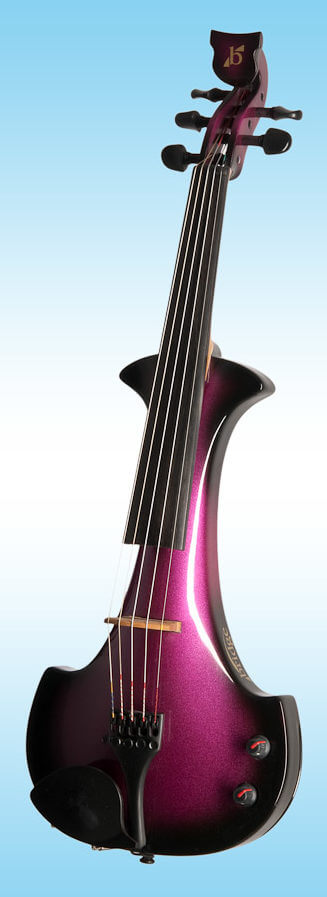 Since a couple of decades there are electric violins, just as there are electric guitar. Usually an electric violin doesn't have a sound box. Because of that they can come in all shapes and forms. The sound is picked up by an element and amplified by an amplifier.
These instruments are popular in bands as they are easy to amplify.
The sound is a little similar to a violin, but of course more 'eletronic'. With pedals and other electronics the sound can be changed.
Have you seen and heard Vanessa Mae playing?
5 String violin
Five string violins come with a lower C string in addition to the G, D, A and E string. In this way the instrument has the range of a violin and a viola. Most of the times these instruments are electric violins. If can be fun as you can play a bass line on the low C string, loop it and play a melody on the higher strings.
Silent violin
Some electric violins are called silent violins. These violins are not silent, because you'll always hear the sound of the bow touching the strings. They sound a bit like a normal violin with a mute. The idea is that you can practice without bothering your neighbors. Silent violins usually have a good sound on ear plugs, but lots of times a bit less sound quality on an amplifier. When buying an electric or silent violin, make sure you know for what purpose you want to use it and test it in all situation (practicing at home, amplified and on stage).
FREE Violin Scale Book
Sensational Scales is a 85 page violin scale book that goes from simple beginner scales with finger charts all the way to all three octave scales and arpeggios
Different sizes of violins
Children's violin
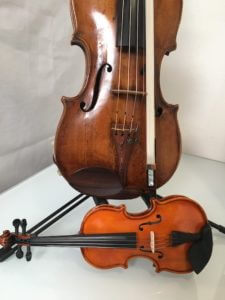 Children can start on the violin from a very early age. Some violinists even started at two years old! The average age to start with the violin is six to nine years old. This is suitable for most children. An earlier age depends on the character and concentration span of the child.
The be able to play in a comfortable and good way, it's important to have the right size violin. This depends on the length of the arm, hand and fingers. There are size charts online and they can differ a bit. It's best to visit a violin shop and have a professional (your teacher?) chose the right size. It can be very personal.
The 4/4 violin is the regular size for adults
Some adults find that they have to stretch too much, for example with their pinky. The solution to short arms and fingers or stiff joints, can be to go for a 7/8 size. It's a tiny bit smaller, but it can be a lot more comfortable. The 7/8 is sometimes also called a 'lady's violin'. Sounds fancy, doesn't it?
Usually children skip the 7/8 size and go straight from a 3/4 to a 4/4 sized violin.
Don't think that a 1/4 violin is sized a quarter of a 4/4 violin. The difference between two sizes is about an inch.
Here's a chart to give you an idea:
Viola's and cello's for children
Yup, kids can start right away on the viola or the cello! Cello's are sizes with the same terms as the violin. The viola's are sized in inches. An adult size is a sound box size of 15 or 16 inch. A 14 inch viola is as big as a 4/4 violin, a 13 inch viola is sized as a 3/4 violin etc. Sometimes violins are stringed as viola's for children, but this doesn't give the deep viola sound your kid might desire.
Now I'd love to hear from you!
What fact was most interesting to you? Leave a comment below. I'm looking forward reading them.


