With almost the same playing technique as your violin, you can easilly pick up a deep and warm sounding instrument: the viola!
Playing the viola as a violinist expands your possibilities in sound colors and playing together
As a bonus your violin playing will be more effortless if you play the viola
Many famous violinist, like Janine Jansen, have made recordings with the viola. Many violin teachers recommend playing both, because it improves your technique and tone creation.
You're special when you play viola!
Orchestra's and quartets are often looking for a good violist. If you want to play together, it will be easy to find an ensemble.
Is there an orchestra that you want to join? Maybe there's a waiting list for violinist, but most of the time there's a shortage of violists.
For adult beginners, the viola is a good instrument to chose if your ambition is to play together with others.
Isn't it difficult or confusing when you pick up the viola next to the violin?
In contrary! Playing the viola will benefit your violin playing. You'll play lighter with a relaxed technique.
By having to get used to larger distances between the fingers, your intonation (playing in tune) will improve. You learn to trust on your ears and adjust to what you hear.
You learn a lot about bowing technique and tone production. Playing the viola you have to adjust to a larger instrument with a different response. You learn a lot about proportions and adjusting your technique to the sound you desire.
5 Steps to learn the viola for violinists
The first time you play the viola, you'll instantly enjoy the warm and deep sound. It will be a bit difficult to bow straight on the right contact points, as the instrument is larger. You'll have to get used that your left hand is a bit further away from your body and you'll have to stretch your fingers a bit to reach the notes.
Step 1: What to look for when buying a viola
First of all it's important that you find the right size for you. The best way to find out is to visit a violin shop and try out different sizes. Viola's are measured in inch. The most regular size is 16 inch, which is the size of the soundbox. When you find this too large, 15 inch might be better for you. Please note tht the sound won't be as deep and full as a 16 inch. Read more in my viola size guide.
Sound and size
The viola has her characteristic sound, because the size of the instrument is in fact too small. A cello sounds an octave lower than a viola. The viola should be bigger to match it's pitch, but it wouldn't be possible to hold it under your chin.
The larger the viola, the more it will have the deep and full sound of the cello. The smaller the viola, the more it will have the bright sound of a violin.
Of course the sound also depends on the quality of the instrument: the tone wood that is used and the maker who built it.
Step 2: How to Hold and Tune the Viola
The viola is larger and heavier than the violin. This can cause problems around holding the instrument and finding a suitable chinrest and shoulder rest.
As a violist it's even more important that you work on a relaxed and balanced hold.
A lot of people make the mistake that they clench the viola between their shoulder and chin. This causes a tensed sound and possible injuries.
It's important to support the viola partially with your left hand and let it rest on your collar bone. I like to play the viola without shoulder rest. You must find a good balance.
When looking for a comfortable chinrest and shoulder rest for the viola, don't be fooled to solve all your problems. It's always 80% playing technique (hold, relaxation and balance) and only 20% rests. Don't spend too much time and money on different rests while not working on your basic technique.
Step 3: Bowing technique on the viola
To get that full and deep viola sound you desire, you'll have to play with more weight than you do on the violin.
The frequency of the notes is lower, the instrument is larger and the strings are thicker. It needs some more 'force' to get those string moving and make a sound with core. This is why a viola bow is heavier and thicker than a violin bow.
It's important that you have a viola bow that can make your viola speak and get a good response. The CodaBow Joule is a viola bow I recommend in my violin shop in Holland. Als the stiff and light Müsing bows for viola might be the solution to your problem.
In playing viola it's even more important you know the difference between weight and pressure
When you play in a forced way pushing the bow into the string, you 'kill' or 'suffocate' the sound and your effort won't results in the tone quality you desire. This won't get you a full sound and the unnecessary force and tension might even lead to injury.
Instead relax your right shoulder and arm. Transfer the weight of your arm into the bow through your index finger. Lean on the bow. Your bow hold should be slightly tilted to the left (pronation) to transfer the weight successfully. It's like you turn a key a bit to the left. Your bow hold should be flexible and relaxed, so your bow can resonate optimally and your bow changes are smooth.
FREE Violin Scale Book
Sensational Scales is a 85 page violin scale book that goes from simple beginner scales with finger charts all the way to all three octave scales and arpeggios
Step 4: Play in tune on the viola
When you normally play and correct your pitch by ear, it won't be difficult to hit the right notes on the viola. You'll notice yourself when it's not right and you'll get used to the larger distances within days or weeks.
Do you play with stickers on the fingerboard, you'll have to work on your ear training. This will benefit your violin AND your viola playing. It's very valuable to learn this.
4 Tips for left hand technique on the viola
Even if you know where you should be by ear, hitting the right notes can be a stretch for your hand. Try to pivot your lower arm, so your knuckles are more in line with the neck of the viola. The smaller the distance between your knuckles and the neck, the easier it is for your fingers to reach the right spots.
Your fingers should land on the string from above like little hammers. Make sure to embrace the viola with your left arm properly.
Yup, the fourth finger can be a challenge! It can help to place your thumb opposite your second or even third finger instead of the first finger.
It's possible that you can't put all four fingers at once on the viola. When you place the third or fourth finger, it can help to lift the first or second finger. Going up for example a scale, your hand rolls from the first finger to the fourth finger.
Step 5: How to read in the viola cleff
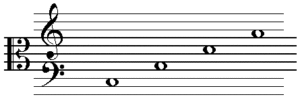 Violists read in a different cleff: the C cleff. Reading notes is the biggest challenge violinists experience when picking up the viola. The note C is on the middle line of the staff. This means that the note you see is seven notes lower than in the violin cleff. An easier way to look at this is that the note you see is an octave higher and a note lower than the note that should sound. In the image on the right you see the F cleff (cello and piano left hand), the C cleff (viola) and the G cleff (violin).
How to get used to the viola cleff
Start with simple tunes, perhaps from a beginner book. While you are playing, say the note names out loud. It's really important you know what you play (note name, grip, sound). Play more complicated pieces and keep aware of the note names. Within two weeks it's possible to get used to the cleff. After this the best way to get fluent in reading the viola cleff is to join an orchestra and gain experience!
Don't pretend to read in the third position on the violin, because you'll get confused when there are a lot of sharps and flats.
Click here to read about my exercises about learning to read in a different cleff.
Yeah, I walk my viola talk!
I made an arrangement of Saint-Saëns 'the Swan' and recorded it playing on a viola while I just picked up the viola for a couple of days. Listen to the recording and download the free sheet music here!
Are you ready to pick up the viola?
Let me know your experiences in the comments below. I always love reading your musical journeys!


